Last updated November 18, 2026



Free written scope consultation - allowances, timeline, and change-order rules on paper before a single trade is scheduled
Driveway & Pavers Troubleshooting in Whitney: Common Problems and How to Fix Them
A single cracked paver is rarely the problem. It’s a symptom report from the sub-base underneath, and the pattern of that crack tells you what the base is doing. Most Whitney homeowners who patch the surface without reading that report end up spending money twice: once on the cosmetic fix, and again when the real failure pushes back through a season or two later. In this guide we walk through how to read the damage before you spend a dollar on repair. You’ll learn how crack geometry separates surface wear from base failure, why edge pavers fail first here and what that reveals about drainage and restraint, how decomposed granite sub-bases invite weeds and ants in Nevada’s climate, what to do about efflorescence from hard water, and how to decide whether a repair will hold or replacement is the only path that makes financial sense.
Quick Answer
Most driveway and paver problems in Whitney trace back to installation details, not bad material: an under-compacted base, missing or shallow edge restraint, or drainage that sends water under the pavers instead of off them. Surface issues like loose sand, minor staining, or a hairline crack can usually be repaired. Widespread settlement, heaving, and cracks that travel in a line or web pattern point to base failure, which means lifting and rebuilding the base rather than patching the top. Reading the symptom correctly is the whole game.
Styles & brands we work with
- Kitchen remodeling
- Bathroom remodeling
- Home additions & ADU
- Roofing
- Windows & doors
- Driveway & pavers
- Fence
Table of Contents
- How Crack Pattern Geometry Tells You What Failed
- Why Edge Pavers Fail First in Whitney
- Weeds and Ants in Decomposed Granite Sub-Bases
- Efflorescence and Mineral Staining from Hard Water
- Settlement, Heaving, and What Nevada’s Soil Does
- Repair or Replace: The Decision Tree
- A Step-by-Step Diagnostic You Can Do Yourself
- Maintenance That Extends Paver Life in Whitney
How Crack Pattern Geometry Tells You What Failed
The shape and direction of a crack is the most reliable diagnostic tool you have, and it costs nothing to read. Before you call anyone, walk the driveway in Whitney and map where the cracks run. A single isolated crack across one paver is surface stress. A crack that runs in a straight line across many pavers is a base seam. A spiderweb pattern radiating from one point is a point load or a soft spot underneath.
Here’s how to read the geometry:
- One crack, one paver: Usually traffic stress or a manufacturing flaw in that unit. Pop it, reset it, done. This is a cosmetic repair.
- Straight line across multiple pavers: The crack is following a seam or joint in the base material, or a transition between two base sections that weren’t keyed together. This is a base issue, but a localized one.
- Spiderweb from a single point: A soft spot, a void, or a point load (a jack stand, a heavy trailer tongue). The base failed under that one spot.
- Stair-step pattern along a diagonal: The pavers are sliding because edge restraint failed or the base is spreading. This one rarely stays contained.
- Wide gaps opening between pavers: The joint sand is gone and the pavers are migrating. Left alone, sand loss becomes paver movement, and movement becomes base failure.
In Whitney, the most common pattern we see is the straight-line crack that follows a base seam, usually where two sections of base were compacted separately without being tied together. The paver on top is fine. The seam underneath is what moved.
Why Edge Pavers Fail First in Whitney
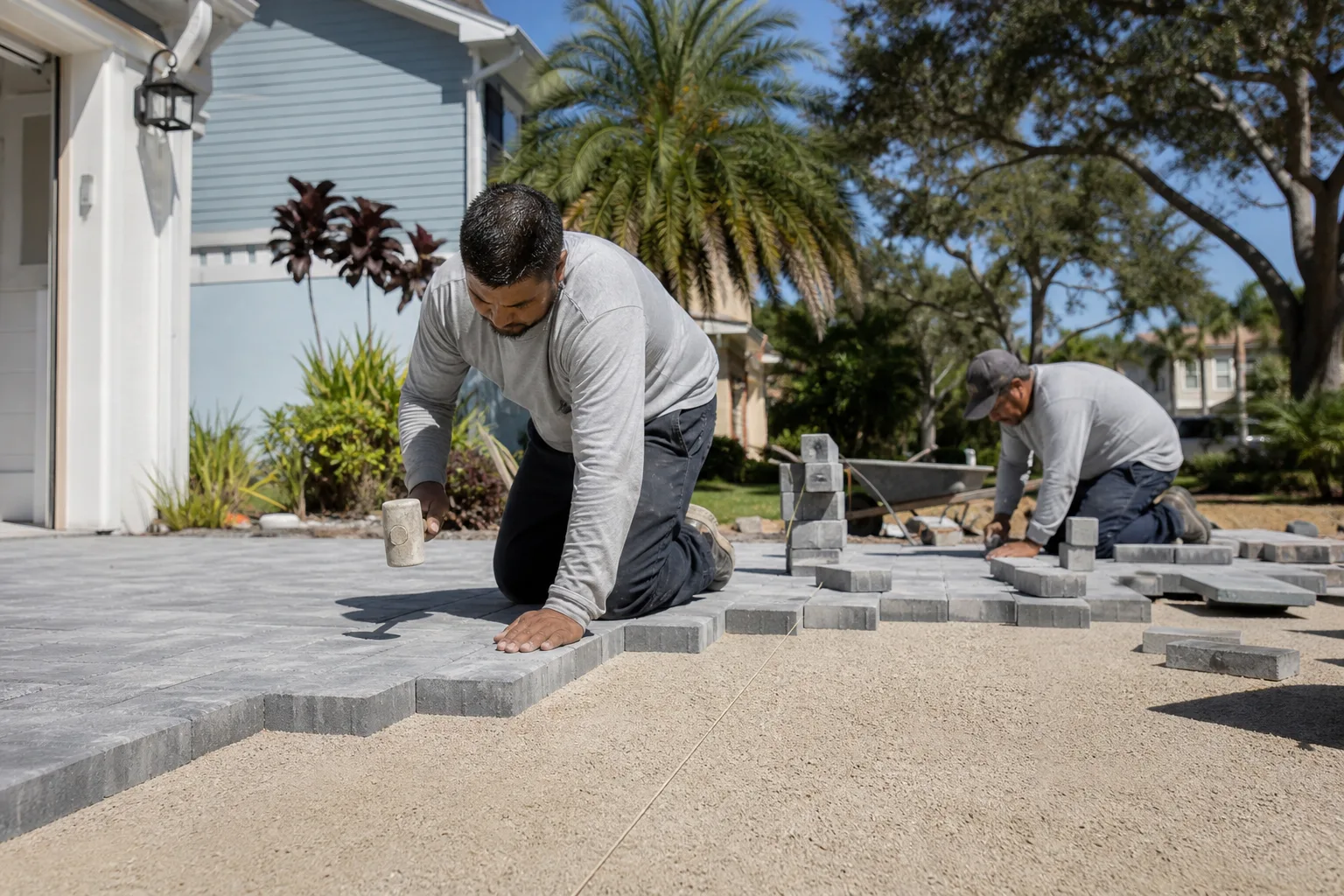
The pavers at the edge of a driveway do more work than they look like they’re doing. They hold the field in place. When they fail, the failure spreads inward, which is why edge damage is the first thing a trained eye checks. In Whitney, edge failures cluster around two causes: inadequate restraint and drainage that pushes water against the edge instead of away from it.
Edge restraint is the hidden component. It’s a small plastic or aluminum L-shaped channel that locks the border pavers in place against lateral movement. When it’s missing, undersized, or installed too shallow, the pavers at the perimeter start to creep outward under traffic. Once one edge paver moves, the ones next to it follow.
Drainage is the second driver. A driveway in Whitney that grades toward the edge or toward the garage instead of toward the street sends water into the base along the perimeter. Wet base loses compaction, and when the base loses compaction, the edge pavers move. You’ll see it as:
- Pavers at the edge sitting lower than the field
- Gaps opening between the border pavers and the ones beside them
- The border lifting as the field settles, creating a visible step
- Sand washing out along the edge after a rain
If the edge pavers are still tight but the field has started to settle, you’re catching it early. Repairs at that stage are usually confined to lifting a few courses, recompacting the base, and resetting. If the whole edge has fanned out and the border is loose, the base probably needs a rebuild in that section.
Weeds and Ants in Decomposed Granite Sub-Bases
Weeds growing through paver joints and ants nesting under the pavers look like two problems. In Nevada’s climate, they usually share one cause: a decomposed granite or crushed aggregate sub-base with voids in it. Decomposed granite compacts well, but it’s porous and it doesn’t seal. In Whitney’s dry, hot conditions, that porosity creates a specific pattern of intrusion that’s different from what homeowners in wetter parts of the country deal with.
Weed seeds blow in, land in the joint sand, and germinate with the first moisture that reaches them. Because the base stays dry most of the year, the roots don’t rot off the way they would in a wet climate. They follow voids in the base and come back season after season. Hand-pulling them just breaks the tops off.
Ants work the same voids from underneath. The colony moves into the base, excavates further, and eventually the sand between pavers starts to disappear as excavation pushes it upward or sideways. The classic sign is small mounds of sand at the joints, which looks like a failed joint but is actually active base excavation.
What actually works:
- Re-sand the joints with a polymeric joint sand, not plain sand, so the joint locks and weed seeds have nowhere to land.
- Address the base voids instead of the surface. Weed and ant treatment without compaction of the voids is temporary.
- For a persistent ant colony, treat the base, not the pavers. Bait placed in the joint travels back to the colony.
- If the base is badly porous and the problem keeps returning, that’s the signal that the base needs to be rebuilt with a properly graded, machine-compacted material.
Weeds and ants in Whitney are usually a base signature. Read the pattern first.
Efflorescence and Mineral Staining from Hard Water
Efflorescence is the white, chalky powder that appears on paver surfaces, and in Whitney it’s tied to the area’s mineral-heavy water. Water carries dissolved salts into the paver, then evaporates off the surface, leaving the salt behind as a crust. New installations make it worse because the material still has moisture to release.
It’s not damage. It’s a reading of what’s happening inside the paver and the base, and it usually resolves on its own as the material dries and the salt washes off. What matters is how you treat it, because the wrong treatment can do real harm.
What to avoid:
- Acid washing. Acid is the fastest way to strip efflorescence, and the fastest way to void a manufacturer warranty on a Belgard, Unilock, Tremron, or Techo-Bloc product. It also etches the surface and opens pores that trap more salt.
- High-pressure washing. It drives water deeper into the paver and the joint, which pulls more salt to the surface.
- Wire brushing. It scratches the surface and creates permanent marks.
The right approach is a soft brush, a light dry brushing once the surface is dry, and time. If the salts are tied to mineral content in hard Whitney water sprinkling the driveway or patio, stop the sprinkler contact with the pavers. Irrigation water is the usual culprit, not rainfall. Where efflorescence is persistent, a manufacturer-approved efflorescence remover is the tool, and only that. Keeping the warranty intact matters more than a fast result.
Settlement, Heaving, and What Nevada’s Soil Does
Whitney’s soil is a big part of the story, and it’s the piece most cheap installations ignore. The soil here drains fast, but it also shifts with seasonal moisture swings. When a base is under-compacted or too thin, the soil below it takes on moisture during a rainy stretch and expands, then contracts as it dries. The pavers follow that movement from underneath, which shows up as settlement in one section and heaving in another.
Settlement vs. heaving reads differently:
- Settlement: Pavers sink. You’ll see a dip, standing water after rain, and joints opening wide. It’s usually a base compaction failure.
- Heaving: Pavers rise. You’ll see a hump or a ridge, and the surface may feel bouncy underfoot. It’s usually driven by soil expansion or frost-like movement from moisture in a poorly drained base.
The tell in Whitney is proximity. Settlement and heaving usually show up within a few feet of each other, and that pairing means the base is moving as a unit, not failing in one spot. A single dip is a repair. A dip and hump together is a base rebuild in that section. Getting this distinction right is the difference between a fix that lasts and a fix that comes back.
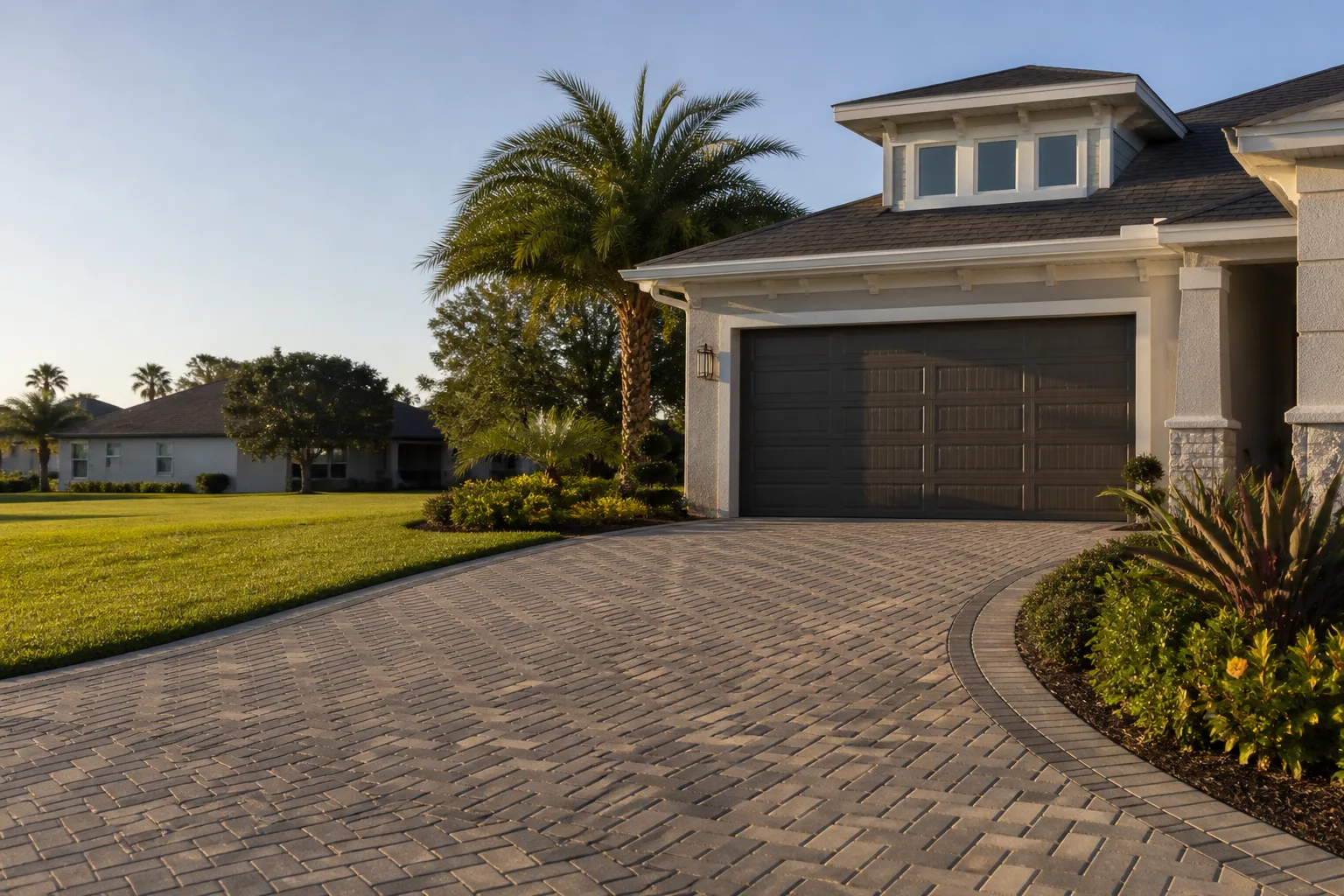
A properly built base for a Whitney driveway is machine-compacted in lifts and graded so water moves off the surface toward the street or a drain. If the base is right, the surface holds for years. If the base is wrong, the best paver in the catalog won’t save it. When we specify a rebuild, we pull from the driveway & pavers line, and the base specification is where the real work is done.
Repair or Replace: The Decision Tree
This is the question homeowners actually want answered, and there’s a clean way to work through it. Use the following sequence. If it leads you to replacement, that’s not bad news: it’s the cheaper answer over a ten-year horizon, because patching a failed base means paying twice.
- Is the damage confined to the surface? Loose sand, minor staining, one isolated cracked paver, a few weeds. Yes = surface repair. No = continue.
- Are the cracks following a base seam or a line? Yes = localized base repair. Pull the pavers in that zone, recompact the base, reset. No = continue.
- Is more than 20% of the driveway showing movement? Settlement, heaving, spreading edges, or cracks across multiple zones. Yes = full base rebuild in the affected area. No = continue.
- Has the same repair already been attempted? If a section has been patched once and failed again, stop patching. The base is the problem. Replace the base.
- Are the pavers themselves still sound? If the pavers are intact but the base is bad, the pavers can usually be pulled, cleaned, and reinstalled over a new base. If the pavers have spalled or cracked from base movement, new material is the right call.
In Whitney, the answer we see most often is the localized base rebuild: the field is fine, one zone is failing, and the rest holds. That’s a good outcome, and it’s typically a fraction of the cost of doing the whole driveway. Where the whole surface is moving together, replacement is the cost-effective path because the labor to rebuild in sections approaches the labor to do it once properly.
A Step-by-Step Diagnostic You Can Do Yourself
You can map the problem before you call for an estimate, and doing so makes the estimate more accurate. Walk through this in order. It takes about twenty minutes.
- Map the cracks. Walk the driveway and trace every crack with chalk. Photograph the trace. You’re looking for lines, spiderwebs, or stair-steps, and where they start and stop.
- Test for voids under the pavers. Tap the pavers with a screwdriver handle. A hollow sound over a wide area means the base has separated from the pavers underneath. A solid sound means it’s tight.
- Check the edge. Press down on the border pavers at the edge. Any movement, or a visible gap opening between the border and the field, is an edge failure signal.
- Pour a bucket of water at the high point. Watch where it goes. It should move to the street or a drain. If it pools toward the garage or sinks into the joints, drainage is a factor.
- Look for sand mounds at the joints. Mounds mean ant activity in the base or joint sand washing upward. Either way, the base is porous.
- Look for efflorescence. White powder means moisture is moving through the paver. Note where it appears. It’s often the same zone where the base is under-draining.
- Check the age of the failure. If the same section has been repaired before, ask why the first repair failed. The answer is almost always “we didn’t rebuild the base.”
Take the photos, map, and notes into your estimate. It’s the difference between a guess and a plan. That’s also true across the rest of the exterior. If you’re planning to coordinate the driveway with fence installation or a home additions & ADU project, doing that diagnostic once gives you one plan for the whole site.
Maintenance That Extends Paver Life in Whitney
Most paver driveways don’t fail from age. They fail from a maintenance gap in the first few years, and it’s usually a small one. The following routine is what keeps a Whitney driveway holding its specification for the long run.
- Re-sand joints when they start to look low. In Whitney’s climate, joint sand wears out from traffic and wind, not rain. A joint that’s low loses its lock and lets pavers move. Polymeric sand is the better choice here.
- Keep irrigation off the pavers. Sprinkler contact is the main driver of efflorescence and the slowest, most preventable cause of base saturation. Point heads away from the driveway.
- Check the edge after a hard rain. Any visible separation or movement in the border pavers gets fixed at the first sign, not after the fence line starts to move. The same principle applies to a fence installation; the base does the work and the surface shows the result.
- Clean the surface without acid or pressure. Blend the maintenance with a soft brush and a hose. Acid and high pressure cut the surface life and can void a manufacturer warranty.
- Address weed and ant activity at the joint, not the surface. Spot treatment, not a blanket spray, keeps the base stable.
These are small habits. They’re also what keeps a paver driveway in Whitney off the replacement list for a long time.
Common Mistakes to Avoid
- Patching the surface without reading the crack. A hairline crack over a moving base will open again in a season. Read the pattern before you buy sand.
- Filling joints with plain sand. Plain sand washes out of a Whitney driveway faster than polymeric sand and lets pavers migrate. It’s a short-term fix at best.
- Acid-washing efflorescence. Fast, and the fastest way to void a Belgard or Unilock warranty. Use a manufacturer-approved remover, or wait for it to dry out.
- Ignoring edge movement. The border pavers are the alarm. By the time the field is moving, the base is already failing. Fix the edge at the first sign.
- Skipping the base on a repair. If pavers are pulled to fix a section, recompact the base underneath. Reinstalling over a soft base is the same repair again in two years.
- Choosing a paver on looks alone. Every hardscape brand works, but the base specification and the install detail are what decide the outcome. Specify the brand, hold the base to spec.
- Letting sprinklers hit the pavers. In Whitney, hard water plus irrigation is the most preventable cause of staining and joint deterioration.
See the difference
 Before
 After
 Before
 After
 Before
 After
When to Call a Professional
Some problems are cosmetic and some are structural, and a few shouldn’t be touched by anyone but a trained crew. If the pavers are moving across more than one zone, if a dip and a hump appear together, if the border has fanned out, or if a repair you’ve already made has failed within a couple of years, it’s time to call. If you’re not sure, the cheap move is an on-site look rather than another bag of sand. Construction Whitney offers free estimates in Whitney. Our technicians have up to 11 years of experience, and we pull from a full hardscape roster including Belgard, Unilock, Tremron, and Techo-Bloc, so specification isn’t limited to whatever someone happens to have. The written estimate is itemized, the base spec is in writing, and the price is set there, not adjusted later. Call (844) 761-9669. We answer 24/7. Fast dispatch from 7am to 7pm, Sunday through Friday.
Frequently Asked Questions
Most cracks come from base failure, not bad pavers: an under-compacted base, a seam between base sections, or poor drainage that saturates the base. Straight-line cracks follow base seams, spiderweb cracks mark a soft spot or point load, and diagonal stair-steps point to edge restraint failure. Call (844) 761-9669 for an exact diagnosis and a free estimate.
Look at the pattern. A single isolated crack or some loose sand is surface wear. Cracks that stay in a line or web pattern across multiple pavers mean the base underneath is moving. Tapping the pavers for a hollow sound over a wide area confirms the base has separated. If it’s a base problem, patching the top won’t hold.
Yes, with the right method and a little patience. Efflorescence is soluble salt that comes to the surface as moisture evaporates. Dry brushing with a soft brush and letting the pavers dry out handles most cases. Avoid acid washing and high pressure, which can etch the surface and void the manufacturer warranty. Call (844) 761-9669 if it’s persistent enough to need an on-site look.
That pattern means the base is moving as a unit, which in Whitney is usually driven by soil moisture swings under an under-compacted base. The soil takes on water and expands, then contracts as it dries, taking the pavers with it. A dip and a hump within a few feet of each other is the signature, and it usually means a base rebuild in that section rather than a spot repair.
A properly built base – machine-compacted in lifts and graded for drainage – holds up for many years, with joint sand and edge checks as the only routine maintenance. A base built thin or loose shows symptoms within a few seasons. The base specification, not the paver brand, is what sets the timeline. Call (844) 761-9669 for a free estimate that puts the base spec in writing.
Repair the section if the damage is confined to one zone with the rest of the field solid. Replace the base if more than about a fifth of the driveway is moving, or if a repair has already failed once. Localized base rebuilds are usually far cheaper than replacement in Whitney because the pavers often can be reset over a new base.
The Bottom Line
Most driveway and paver problems in Whitney are installation failures that surface later, which is why the symptom is your best diagnostic. Crack pattern tells you whether the failure is surface or base. Edge movement tells you drainage and restraint are suspect. Weeds and ants point to a porous base. Efflorescence points to moisture moving through the paver and irrigation hitting the wrong place. Read the symptom first, and you’ll know whether a cosmetic fix will hold or a base rebuild is the only cost-effective path. A base done right, with the material specified by you, keeps the surface where it belongs. If you want that read from a trained eye, we’re here.
Construction Whitney works across seven service categories under one contract: driveway & pavers, fence installation, home additions & ADU, bathroom remodeling, windows & doors, roofing, and kitchen remodeling. For the driveway at the curb or the kitchen at the center of the house, it’s one contractor and one accountable scope. Visit Construction Whitney or call (844) 761-9669 to book your free estimate. We answer 24/7. Fast dispatch from 7am to 7pm, Sunday through Friday.
Written by the team at Construction Whitney.